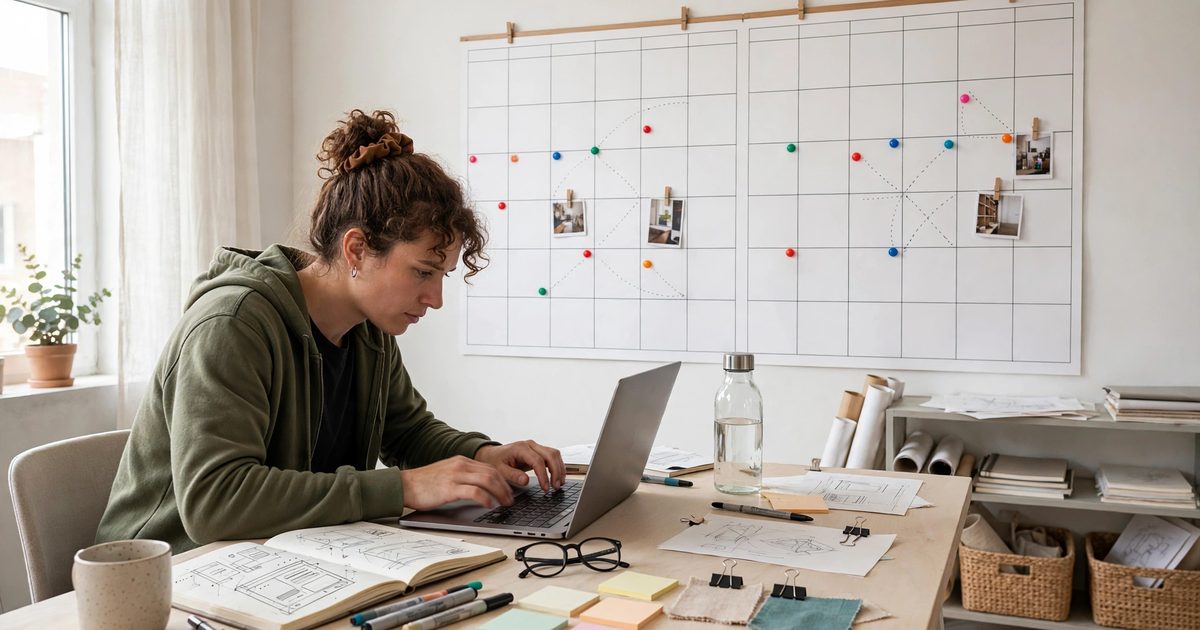
A fast turnaround web design project can deliver a five-to-eight page business site in two weeks, sometimes one, on three conditions: the content is ready before day one, the design starts from a proven template or design system rather than a blank canvas, and the client can approve things within a day. Miss any of the three and the same site takes six to eight weeks, which is the normal timeline for a reason. Fast projects are not rushed projects; they are projects with the waiting removed. This post shows what a two-week build looks like day by day, which sites qualify and which do not, what a fast project costs relative to a standard one, and the questions to ask any designer offering a quick turnaround.
What does a fast turnaround web design project look like, day by day?
| Day | Designer | Client |
|---|---|---|
| Before day 1 | Sends questionnaire, content template and asset upload link | Returns copy, images, logo, logins; books the two review slots |
| 1 | Kickoff call: page list, structure, template or system choice, brand direction | Decisions on the call, not after |
| 2 to 3 | Home page and one inner page designed in the platform (no separate mockups) | Reviews within 24 hours; one round of changes |
| 4 to 6 | Remaining pages built; forms, integrations, mobile layout | Provides anything missing the same day |
| 7 | Full site review | Consolidated feedback in one list, one round |
| 8 to 9 | Revisions; SEO titles and descriptions; image optimisation against Core Web Vitals; redirects from the old site | Signs off |
| 10 | Domain connection, Search Console, analytics, final checks | Confirms live site |
| 11 to 14 | Buffer for DNS, last fixes, handover training | Records the walkthrough |
Note what is missing: no separate wireframe and mockup stages, no three rounds of revisions, no waiting for copy. Those are the things that take the normal five to seven weeks of a custom Showit build, and they are removed by preparation, not by working faster.
Which projects can be built fast?
| Fits a fast turnaround | Does not |
|---|---|
| 5 to 10 pages on Squarespace, Showit or WordPress with a design system | 20+ pages or a large blog to migrate |
| Content written and photos taken before the start | Copy to be written during the project |
| One decision-maker available daily | A committee, or a founder travelling |
| A template or a designer’s own system as the starting point | A fully custom design explored from scratch |
| Standard integrations: forms, booking, newsletter, one payment method | Custom shop logic, memberships, complex integrations |
| A brand that exists: logo, colours, fonts | Branding still to be created |
| Redesign of an existing site with a clear structure | A site that needs its content and structure rethought |
Most small business sites fit the left column if the owner does the preparation. The projects that go wrong are the ones that were in the right column and were sold a fast timeline anyway.
How do designers deliver fast without cutting corners?
- A design system, not a blank page. Tested section layouts, typography and colour tokens, button styles; saved sections on Squarespace or a component library on Showit and WordPress. The design is still tailored; the scaffolding is not rebuilt each time.
- Design in the platform. Skipping Figma mockups and building the real site from day two removes a whole review cycle and the mockup-to-build translation errors.
- Content first. The onboarding process is compressed into the week before the project, with a content template the client fills in.
- Fixed review windows. Two reviews, 24-hour turnaround each, feedback consolidated into one list. Not fewer revisions, but no waiting between them.
- A checklist for launch: SEO fields, redirects, image sizes, forms tested, analytics connected. Speed comes from not having to remember.
What does a fast turnaround cost?
Usually the same as a standard project of the same scope, sometimes 10 to 25 percent more for a guaranteed short window, because the designer blocks the fortnight for one client. Cheaper “48-hour website” offers are template installs with your text pasted in; they can be fine for a placeholder and rarely for a business site. One agency’s honest breakdown of what drives timeline and price lands on the same two factors: how quickly the client gives input, and how much is customised. What a website should cost puts figures on the scope side.
What questions should you ask a designer offering a fast turnaround?
- What do you need from me before day one, and what happens if it is late?
- Is the design built from a template or system, and can I see three sites built on it?
- How many review rounds, and how long do I have to respond?
- What is not included at this speed (custom illustration, copywriting, photography, complex integrations)?
- Who owns the site, the domain and the accounts at the end, and what does handover include?
Good answers are specific. The questions to ask a website designer cover the rest, and they matter more, not less, when the timeline is short.
When should you not rush?
- The brand is not settled. A site built on a logo that changes in three months is built twice.
- The structure is unknown. If you cannot list the pages and what each is for, the page-organising exercise comes first and takes a week of thinking on its own.
- The site is the business. A shop, a booking platform or a membership site deserves the testing time.
- Nobody can answer questions daily. The fast timeline needs the client more than the slow one does.
Two-week builds are a real offer on Squarespace projects and Showit sites when the left-hand column above is true, and they are the projects clients enjoy most, because the site exists before the enthusiasm fades. The Squarespace build timeline post shows the standard version for comparison.
Frequently asked questions
Two weeks for a five-to-eight page business site is realistic, and one week is possible, provided the client has done the preparation and can respond daily. Larger or custom sites take the normal six to eight.
A project with the waiting removed: content collected before day one, design built directly in the platform from a design system, two fixed review windows with 24-hour responses, and a launch checklist. The work is the same; the gaps are gone.
A template install with your text and images, yes. A designed business site with proper structure, SEO fields, mobile checks and integrations, no. Treat 48-hour offers as placeholders.
Often the same as a standard project of equal scope, sometimes 10 to 25 percent more for a guaranteed short window. Very cheap fast offers are template installs, not design.
Final copy for every page, photos, logo and brand files, logins for the domain and any tools, a list of pages, and a decision-maker who can respond within 24 hours throughout.
Large sites, shops with custom logic, membership platforms, sites whose branding or structure is undecided, and projects where copy is written during the build or approval goes through a committee.