

Work out both people’s hours in UTC, find where they overlap, then check the overlap still holds after the next clock change. Do that and you’re basically done. The rest of this is the stuff I had to learn the hard way.
I’m in Lahore. We sit at UTC+5 and we never touch the clocks, which sounds like a blessing until you notice everyone else does. My clients are mostly in the States, the UK, and Australia, so my calendar has been a running negotiation for about six years now. One Monday I turned up an hour late to a launch call because Washington had jumped forward over the weekend and my clock, quite reasonably, had not moved at all. The client laughed it off. I did not.
Here’s what actually works, including the parts nobody warns you about.
What Is an Overlap Window, and How Do You Find Yours?
It’s the stretch of hours where everybody on the call is both awake and willing to work. Nail it down once per client and you never have to think about it again.
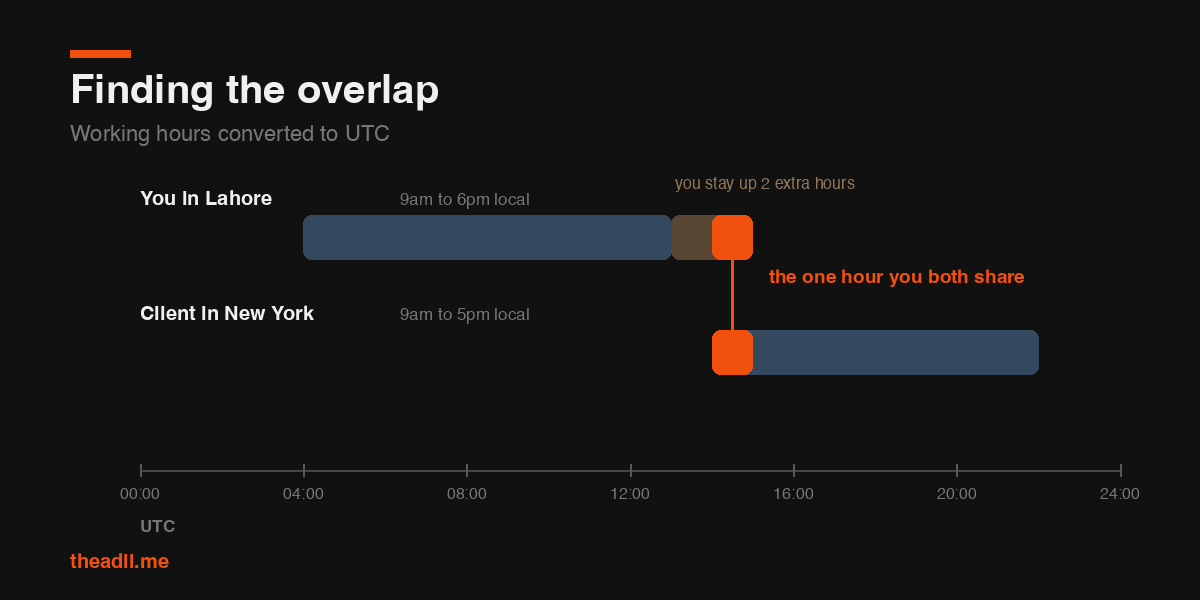
Easiest way I know is to push both days into UTC and see what happens. Take mine: 9am to 6pm in Lahore comes out as 04:00 to 13:00 UTC. Now take a client in New York on winter time, 9 to 5, which lands at 14:00 to 22:00 UTC. Put those side by side. They never touch. Not by one minute.
Which looks fatal until somebody bends. If I keep taking calls until 7pm, that’s 14:00 UTC, and there’s my hour with their morning. Stay up till 8 and I get two. That’s how nearly every long-distance pairing actually works. Somebody stretches. Just make it a choice you made on purpose, not something you find out about at eleven at night.
| My time (Lahore, UTC+5) | New York (EST) | London (GMT) | Sydney (AEDT) |
|---|---|---|---|
| 1:00 PM | 3:00 AM | 8:00 AM | 7:00 PM |
| 2:00 PM | 4:00 AM | 9:00 AM | 8:00 PM |
| 5:00 PM | 7:00 AM | 12:00 PM | 11:00 PM |
| 7:00 PM | 9:00 AM | 2:00 PM | 1:00 AM |
| 9:00 PM | 11:00 AM | 4:00 PM | 3:00 AM |
Read down that table and the shape of my week becomes obvious. London is easy, almost any afternoon works. New York needs my evening. Sydney needs my early morning or nothing at all. I built a free meeting planner precisely because I got tired of drawing that grid on paper every time a new client showed up.
Why Does Daylight Saving Break Everything?
Because not everyone changes on the same day, and some places don’t change at all.
The United States moves its clocks on the second Sunday of March and the first Sunday of November. Europe moves on the last Sunday of March and the last Sunday of October. Australia, being in the southern hemisphere, goes the opposite direction entirely. Pakistan, India, and most of the Gulf simply don’t participate.
Line those dates up and you’ll spot the gap. For about three weeks each March the Americans have jumped and Europe hasn’t. Then in autumn it flips, and Europe falls back roughly a week before the US does. While that’s going on, New York and London sit five hours apart instead of four, and every standing call you own quietly slides by an hour without telling you.
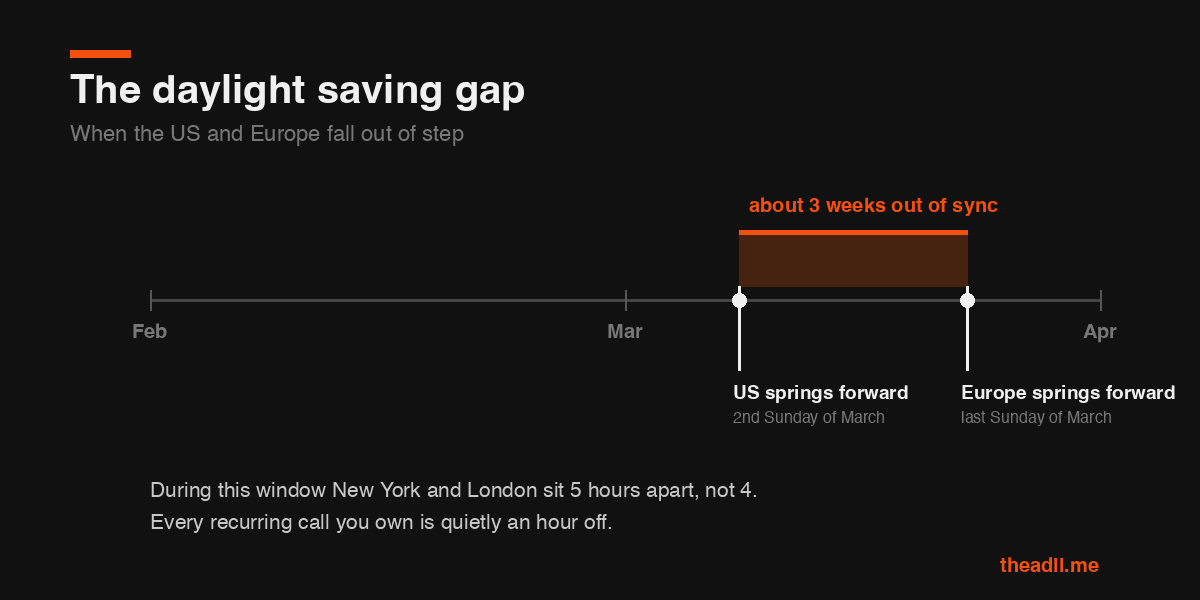
I’d wager more international calls get missed this way than any other, and it catches people who have been doing this for years. So if you remember nothing else here, remember that a recurring slot that works fine in February can be wrong by April. I keep two reminders in my calendar, mid March and early November, just to go back and check my standing calls still say what I think they say.
Whose Morning Should You Give Up?
Whoever is being paid. That’s my honest rule, and it has served me well.
If a client in Denver wants to talk, I take the call at 8pm my time. Not because it’s fair in some cosmic sense, but because they’re the one buying and inconvenience is part of what they’re paying for. I’ve never regretted that call. I have regretted the times I pushed back and made a nervous new client stay up past nine.
The one thing I won’t do is agree to something I can’t sustain. If a project needs weekly calls at 3am my time, that’s not a scheduling problem, it’s a scoping problem, and I say so before we sign anything. Being upfront about your real availability is part of setting expectations properly at the start of a project. Nobody enjoys discovering your limits in week three.
What If There Is No Overlap at All?
Then stop trying to have a meeting.
Lahore and Los Angeles are twelve hours apart. There is no polite time. When I’ve worked with clients who hired me from the other side of the world, we’ve mostly run the project asynchronously and saved live calls for the moments that genuinely need a face: kickoff, one mid-project review, and launch day. Three calls in six weeks, each one scheduled deliberately and painfully, instead of a weekly slot that slowly poisons everyone’s sleep.
What fills the gap is writing things down properly. Loom videos instead of screen shares. A shared document with decisions logged. Screenshots with arrows on them. It’s slower per exchange and faster overall, which surprises people until they’ve lived it.
How Should You Write the Invite So Nobody Gets It Wrong?
Send it from a calendar app, always. Never propose a time in plain text without the zone attached.
Google Calendar, Outlook, Calendly, they all keep the event in UTC behind the scenes and show each person their own local time. That is the whole point of them. Type “Thursday 3pm” into an email and you’ve quietly set a trap for somebody. Send the invite instead and the software does the maths for you, correctly, including across the clock changes.
If you must write a time in a message, write it twice: “2pm your time, 7pm mine.” Ten extra characters, roughly a hundred percent fewer mistakes. And when you’re proposing options rather than confirming, offer three specific slots rather than asking what works. Open questions across time zones generate three emails minimum.
Should You Rotate the Meeting Time?
For a team spread across three or more regions, yes. For a two person client call, usually not.
Rotation makes sense when there’s no time that’s decent for everyone, so you share the pain across weeks. Someone takes the early slot this month, someone else takes it next. Big distributed companies do this and it works.
For freelance work it mostly creates confusion. A fixed weekly slot that the client can rely on is worth more than perfectly distributed inconvenience. Pick the time, keep it, and revisit it when the clocks change.
What Tools Are Actually Worth Using?
Very few, honestly. Most time zone tools do the same conversion with different colours, in much the same way most website builders repackage the same handful of ideas.
What matters is whether the tool shows you a range rather than a single converted moment. Knowing that 6pm Lahore is 9am New York is mildly useful. Seeing that my 5pm to 9pm maps onto their 8am to noon is what actually lets me schedule. That’s the difference between a converter and a planner.
My own meeting planner tool does exactly that and nothing else. Two zones, side by side, no signup. I built it for my own use and left it public because a few clients asked for the link. For larger groups, the World Clock Meeting Planner handles many cities at once and is the tool I’d point you to when two zones isn’t enough.
What Mistakes Have Cost Me the Most?
Four, in descending order of embarrassment.
- Assuming the client’s city equals their time zone. A client told me she was “in Australia.” Australia has multiple time zones and only some observe daylight saving. I was an hour out for two weeks before either of us worked out why.
- Trusting a time I calculated in my head at midnight. Tired arithmetic is wrong arithmetic. Now I check even the conversions I’m certain about.
- Not asking when their day actually starts. Plenty of people don’t work 9 to 5. One US client did his best work between 6am and 2pm, which opened a window I’d assumed was closed.
- Setting a recurring call in winter and forgetting about March. Covered above. Still catches me. I keep the reminder now.
Frequently Asked Questions
What is the easiest way to schedule a meeting across time zones?
Put both sets of working hours into UTC, see where they cross over, then send an actual calendar invite instead of typing a time into an email. Your calendar handles the conversion and the daylight saving nonsense on its own, and those two things are where nearly all the mistakes come from.
How do I avoid daylight saving mistakes?
Send invites, not typed out times, and go back through your recurring meetings in mid March and again in early November. Those are the weeks the US and Europe fall out of step with each other, and it’s when standing calls drift by an hour without anyone noticing.
What is the best time to meet between the US and Europe?
Late morning on the New York clock, which puts London and central Europe into their afternoon. Somewhere between 10am and noon Eastern is the sweet spot, nobody’s evening gets touched. Creep past 1pm Eastern and you’re eating into somebody’s dinner.
Should I use UTC when talking to clients?
Only if they’re technical and already live in it. For everyone else write both local times out, “2pm your time, 7pm mine.” UTC is brilliant for doing your own sums and mildly off-putting in a client email.
Is there a free tool for finding meeting times across time zones?
Plenty of them. Mine is free, needs no signup, and handles the two zone case that covers most freelance and client work. Once you’re juggling three or more regions, timeanddate.com’s World Clock Meeting Planner is the one I’d send you to, since it swallows a whole list of cities at once.
How many hours of overlap do you actually need?
Two hours is comfortable. One is doable. Zero means stop scheduling calls and start writing things down instead. And if you only get the one hour, guard it. Don’t burn it on status updates that could have been a two line message.
I’m a freelance website developer working from Pakistan with clients across three continents, so the time zone problem is one I solve most weeks. If you’re hiring internationally and want to know what a realistic working rhythm looks like, my guide on hiring a freelance web designer covers the practical side, and this breakdown of website pricing covers what the work should cost.